Rings Layer
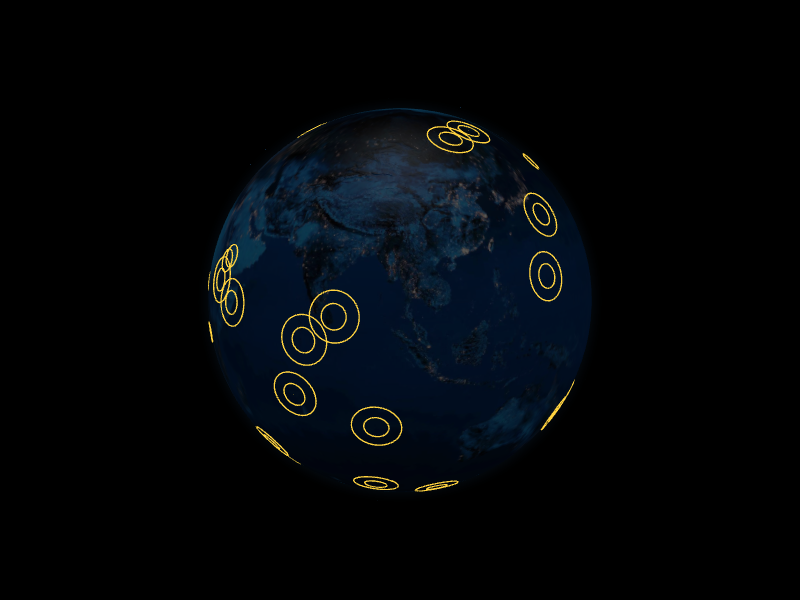
The rings layer animates expanding concentric rings outward from a coordinate,
useful for pings, pulses, or highlighting locations. Each ring is a RingDatum.
from IPython.display import display

from pyglobegl import GlobeConfig, GlobeWidget, RingDatum, RingsLayerConfig

rings = [
    RingDatum(lat=0, lng=0, max_radius=4, color="#ff66cc"),
    RingDatum(lat=20, lng=10, max_radius=6, color="#66ccff"),
]

config = GlobeConfig(rings=RingsLayerConfig(rings_data=rings))

display(GlobeWidget(config=config))
RingDatum
A ring is defined by lat, lng, max_radius, and color, with animation
controls (propagation speed, repeat period) available on RingsLayerConfig.
Custom gradient
RingDatum.color is a single colour or a list of discrete stops. For a colour
that varies as each ring propagates, set a layer-level ring_color_fn — a
frontend Python callback mapping the
propagation parameter t in [0, 1] to a CSS colour string, typed by the
exported ColorInterpolator alias. t is the animation progress: 0 when the ring
is emitted and 1 at the end of its travel. With the default outward propagation
(propagation_speed > 0) that runs from the centre (t = 0) to max_radius
(t = 1); with inward propagation (propagation_speed < 0) the radius is
reversed, so t = 0 is at max_radius and t = 1 at the centre. When set it
overrides the per-datum colour for every ring.
from pyglobegl import ColorInterpolator, frontend_python


@frontend_python
def gradient(t: float) -> str:  # ColorInterpolator: (t in [0, 1]) -> CSS colour
    red = int(255 * (1 - t))
    return f"rgba({red},40,{int(255 * t)},{max(0.0, 1 - 0.6 * t)})"


config = GlobeConfig(rings=RingsLayerConfig(rings_data=rings, ring_color_fn=gradient))
Pass None (the default) to keep per-datum colours, or swap it at runtime with
GlobeWidget.set_rings_color_fn(...).
Sampled per frame
Unlike the arc/path gradients (baked once at data-change time), rings sample this callback once per ring per animation frame as they expand, so keep the body cheap. MicroPython throughput is ample for the handful of calls per frame this involves.
Runtime changes apply to newly emitted rings
As with the other ring style accessors, three-globe captures ringColor when
each ring circle is emitted (it does not rebuild existing rings). So a runtime
set_rings_color_fn(...) takes effect on rings emitted after the call —
a repeating ring (repeat_period > 0) picks it up within one period, but a
static or non-repeating ring keeps its colour until you re-set the data with
set_rings_data(...).
From a GeoDataFrame
rings_from_gdf builds rings from point geometries, carrying through columns
such as max_radius and color. See
GeoPandas helpers.